


.svg)
.svg)
.svg)
.svg)
.svg)

资源
.png)

.png)


.svg)
Hire and manage employees in Austria


The Definitive Manual for Employee Recruitment in Austria
Quick facts
.png)
Austria is a federal republic located in Central Europe, bordered by Germany to the northwest, the Czech Republic to the north, Slovakia to the northeast, Hungary to the east, Slovenia and Italy to the south, and Switzerland and Liechtenstein to the west. It has a population of approximately 8.9 million people, with the capital city being Vienna.
Austria has a strong and diversified economy, with a GDP of $582 billion. It is known for its high standard of living and is consistently ranked as one of the wealthiest countries in the world.
It’s Europe’s land of wide, fertile agricultural plains, with large pockets of heavy industry in the east.
Employment Contracts
An employment contract can be either fixed-term (befristeter Arbeitsvertrag) or of indefinite duration (unbefristeter Arbeitsvertrag).
Probation Period
The probationary period typically lasts for one month, although some collective agreements may specify a shorter period. Apprentices typically have a probationary period of three months. These details should be available at the workplace.
Working Hours
In Austria, the typical work week starts on Monday and ends on Friday. Most people have Saturday and Sunday off. The standard working hours are 8 hours per day or 40 hours per week, usually between the hours of 8 AM and 6 PM. However, some collective agreements may specify a shorter standard working week (e.g. 38.5 hours per week). There are exceptions to this, such as a daily working time of 9 hours being allowed if it results in a longer weekend rest (called a “short Friday”). The weekly standard working hours can be more than 40 hours under certain conditions. Overtime is defined as working more than the statutory 40-hour standard working week or the 8-hour standard daily working time. You will receive at least a 50% surcharge for every hour of overtime worked. If you have agreed to time compensation, you will receive 1.5 hours of compensation for every hour of overtime worked.
Many collective agreements, such as those for night, holiday, and Sunday work, provide for higher surcharges for overtime. It is prohibited to agree to pay overtime at a 1:1 ratio. If there is an increased work requirement, 20 hours of overtime per week are permitted. Daily working hours may not exceed 12 hours and weekly working hours may not exceed 60 hours, including overtime. Collective agreements may allow for even higher levels of overtime, and additional overtime may also be permitted by company agreement.
Vacation Days
Employees are entitled to some of the most generous annual leave entitlements in the world. They are entitled to 25 working days of paid vacation per year, which increases to 36 days after 25 years of service.
Sick Leave
In Austria, sick employees are entitled to full salary for up to 12 weeks, depending on their length of employment. After that, they receive half pay for 4 more weeks. If sick leave is prolonged, social security pays benefits. Sick pay starts from the 4th day of illness and lasts for 26 weeks, up to a maximum of 52 weeks under certain conditions. The amount of sick pay is based on the employee’s salary and is 50% for the first 42 days of illness, then increases to 60%. There is a maximum limit on the amount of income considered for calculating benefits. Employees must inform their employer immediately about any absence and the employer can request a doctor’s note.
Wages and Salary Payment
In Austria, there is no national minimum wage law. Instead, the wages of most workers are determined by collective agreements negotiated by the social partnership, a system of cooperation between unions and employer associations. As per the current IT sector collective agreement in 2026, employees must earn for entry level positions 2.236 EUR gross per month or more. Task groups, advancement levels determine the minimum basic salaries.
In Austria, the 13th and 14th salaries are additional payments known as "holiday" and "Christmas" bonuses, typically paid in June and November, respectively. These payments are taxed at a lower rate, providing employees with extra income to cover summer holidays and year-end expenses.
Public Holidays
The following days are recognized as public holidays in Austria:
- New Year’s Day 01.01.2026
- Epiphany 06.01.2026
- Easter Sunday 05.04.2026
- Easter Monday 06.04.2026
- Labor Day 01.05.2026
- Ascension Day 14.05.2026
- Whit Sunday 24.05.2026
- Whit Monday 25.05.2026
- Corpus Christi 04.06.2026
- Assumption Day 15.08.2026
- Austrian National Day 26.10.2026
- All Saints’ Day 01.11.2026
- Immaculate Conception 08.12.2026
- Christmas Eve bank holiday 24.12.2026 (Half Day)
- Christmas Day 25.12.2026
- St. Stephen’s Day 26.12.2026
- New Years Holiday 31.12.2026 (Half Day)
Employer Taxes
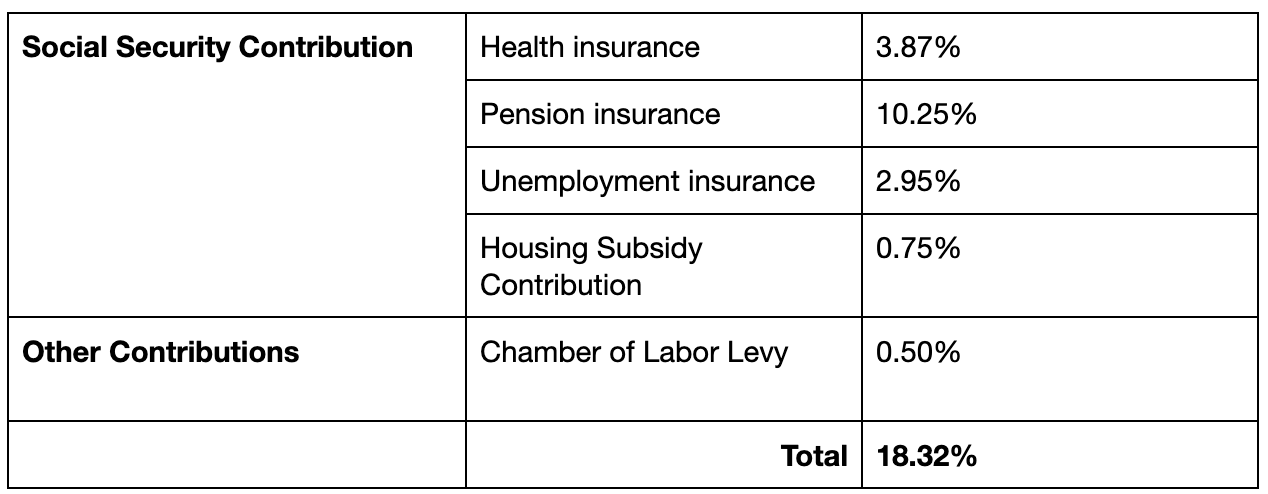
In Austria, employer taxes are divided into two main categories: social security contributions and other contributions. The final amount of taxes paid will vary depending on many factors.
The social security contribution covers health insurance, pension insurance, accident insurance, and unemployment insurance. Additionally, in Vienna, employers pay a public transportation levy of EUR 2 per week per employee. Both the employer and employee contributions must be transferred to the health insurance provider (ÖGK) by the 15th of the following month. In 2026, the monthly marginal income limit is EUR 551.10.
Employee Taxes
Residents of Austria are subject to Austrian income tax on all worldwide income, including income from trades, businesses, professions, employment, investments, and property. Non-residents are only subject to Austrian income tax on Austrian-source income, and the tax rates for this income are as follows:
Annual Income (EUR) | Tax Rate (%):
13,308 and below - 0 %
over 13,308 to 21,617 - 20 %
over 21,617 to 35,836 - 30 %
over 35,836 to 69,166 - 40 %
over 69,166 to 103,072 - 48 %
over 103,072 to 1,000,000 - 50 %
over 1,000,000 - 55 %
These contributions are based on a maximum assessment basis (gross salary) of EUR 6,450 per month for current payments and apply to both employers and employees.
需缴纳社保的收入包括员工基于雇佣关系有权获得的所有货币和非货币福利。
通知期
雇主或雇员均可发出终止雇佣关系的通知,通知形式可以是口头、书面,或通过移交雇佣文件隐性传达。无需说明终止原因。
在奥地利,终止雇佣关系的通知期取决于您的工作类型和工作年限。白领员工可获得雇主至少6周的通知期,并随工作年限增加(最长可达5个月)。蓝领员工可获得至少2周的通知期(集体协议可能规定更长)。员工需提前一个月(白领)或两周(蓝领)发出通知。通知期不得短于法定最低期限,在此期间,白领员工可获得额外的空闲时间来寻找新工作。
终止雇佣和遣散费
公司可在合同中规定,任何一方均可在每月15日或最后一天终止协议。但是,公司在无故终止合同时,必须遵守任何规定的通知期并遵循指定的终止日期。根据遣散费制度,雇主需将员工月薪的1.53%存入名为Betriebliche Vorsorgekasse的遣散基金。雇佣关系结束后,员工可以选择要求支付累计资金,或将其留在基金中以供进一步投资。
常见问题
Does Acvian handle time record submissions?
Acvian does not handle time record submissions directly. It is the client’s responsibility to track and submit employee work hours. However, Acvian can offer guidance and best practices to ensure efficient time tracking and compliance with local labor laws.
员工如何查看他们的工资详情?
员工可以通过 月度工资单 查看他们的工资详情,也可以通过我们的 Acvian 平台。这些工资单包含收入、扣除项、税费和实发工资等信息,让员工对自己的月度工资一目了然。 请注意 在某些国家,由于数据保护法规的限制,雇主无法查看工资单,只有员工才能分享他们的工资单。如需了解这些法规的更多详情,请联系我们的专家。
Acvian 如何处理薪资纠纷?
Acvian 处理薪资纠纷 及时,与 客户 和 员工 双方紧密合作,调查并解决 任何问题。
Acvian是否要求预付月度薪资和服务费?
是的,Acvian要求预付月度薪资和服务费,以确保 及时 和 准确的薪资处理。
Acvian 能否提供有关劳动和税务法规的咨询服务?
是的,Acvian 可以提供咨询服务 针对劳动和税务法规。我们的专家团队精通当地法规,能够提供指导,帮助您的企业保持合规、降低风险,并应对国际雇佣和税务法律的复杂性。
Acvian 提供哪些福利?
Acvian 提供 多样化的福利,包括但不限于:
- 医疗保险
- 汽车租赁
- 健身津贴
- 差旅津贴
- 产假
我们可以 根据客户需求定制并提供多种 福利 ,确保您的员工获得符合公司文化和当地法规的支持与福利。
Acvian 能提供私人医疗保险吗?
Acvian 能提供 私人医疗保险方案,作为其全面的员工福利计划的一部分。
员工的月度/年度费用会是多少?
“平均”套餐的月度/年度费用会因具体方案和地点而异。请查看我们的预估价格套餐 此处。Acvian 团队可以根据您的需求提供详细的费用明细。
Acvian 能否协助实体设立?
尽管 Acvian 不直接提供实体设立服务,我们可以为您引荐专注于此领域的当地律师,以协助您满足您的需求。另请参阅, 何时更适合设立实体或使用 EOR。
员工离职:如何办理?
员工离职流程由 Acvian 以 规范化 和 合规的方式管理。 我们与您的企业协调,确保所有必要的文件、离职面谈和最终款项都已完成。Acvian 还确保遵守当地劳动法律法规,包括提供任何所需的通知期并管理终止流程。
企业何时需要它?
企业通常需要 EOR 和 PEO 服务,当它们:
- 拓展新的国际市场。
- 在国外招聘远程员工。
- 寻求简化全球员工管理。
- 旨在确保遵守当地劳动法律法规。
- 希望减少在海外设立法律实体的时间和成本。
Acvian 符合 GDPR 规定吗?
是的,Acvian 完全符合 GDPR 规定。我们依法收集和处理个人数据,确保数据仅用于一般允许的目的,例如营销和其他合法商业活动。
你们提供劳动合同吗?
是的,Acvian 提供永久性合同和固定期限的 劳动合同,且可续签。在第二次续签后,合同将变为无固定期限合同。
员工如何查看他们的工资单?
员工可以通过每月收到的 工资单 以及通过 Acvian 平台。
Acvian 可以在哪些国家提供 EOR 服务?
Acvian 可以在超过 180 个国家提供 EOR 服务,覆盖几乎所有欧洲国家、美国和加拿大,提供广泛的覆盖范围,以支持您的业务全球扩张和劳动力管理需求。查看我们的覆盖范围 此处。
EOR模式下薪资发放如何运作?
在EOR模式下, Acvian负责管理薪资发放流程 通过以下方式:
- 担任您海外员工的法定雇主。
- 处理薪资计算、扣款和发放。
- 确保符合当地税务和劳动法规。
- 管理薪资税、社会保险和福利。
- 为您的员工提供及时准确的薪资处理。
了解详情 此处。
您能为外籍EOR员工提供支持吗?
外籍员工支持的具体内容是什么?
Acvian 提供的外籍员工支持 涵盖一系列服务 旨在帮助在海外工作的员工顺利过渡。主要方面包括:
- 协助办理签证和工作许可的申请、续签和合规事宜。
- 提供搬迁支持,包括住房、子女教育和当地注册。
- 提供当地税务法规和申报方面的指导。
- 协调符合当地规定的福利和保险。
- 为外派期间可能出现的任何变动或问题提供持续支持。
入职后会发生什么?
入职后, Acvian 保持 与您的企业和员工保持持续的关系,确保薪资处理顺畅,管理税务和法规合规性,处理福利管理,并为雇佣生命周期中可能出现的任何变化或问题提供支持。这 让您能够专注于您的核心业务 运营,而 Acvian 则负责管理您的国际员工。
我们的员工办理入职需要多长时间?
入职流程通常需要 2到4周,具体取决于所在国家和员工情况的复杂程度。然而,Acvian 致力于加快 这一流程,确保您的员工顺利高效地完成过渡。 查看我们紧急雇佣项目的案例。
Acvian是否为员工咨询或协助请求提供本地支持?
是的, Acvian为员工提供本地或区域支持 咨询和协助请求。我们在您员工所在的支持国家/地区设有专门的经理,确保提供及时、专业的协助,并符合当地法规和惯例。


.svg)