
.svg)


.svg)
.svg)
.svg)
.svg)
.svg)

资源


比荷卢三国:比利时、荷兰和卢森堡外籍人士移居比较指南
Known as the Benelux Union, or simply Benelux, the three neighboring countries of Western Europe – Belgium, the Netherlands, and Luxembourg – formed a customs union in 1948 that would later evolve into a broader model of regional economic cooperation. Despite shared borders and relatively modest territories, the region is a study in unity in diversity, with a patchwork of both official and unofficial languages shaped by centuries of sitting at the crossroads of Germanic and Latin Europe, and cultural distinctions that shouldn’t be overlooked before settling on your ideal destination among the three.
.png)
Among the things the Benelux member states do have in common is consistently ranking high in the World Happiness Report. Robust EU economies, strong safety records, and high standards of living make all three countries attractive destinations for expats. In this comparative guide, we take a closer look at the regional immigration landscape, visa paths, tax regimes, and practical realities across Benelux, with a major focus on Belgium and the Netherlands.
💡Looking for a detailed expat guide to Luxembourg? Click here to explore.
Immigration landscape and employment opportunities in Belgium, the Netherlands, and Luxembourg

In other words, who is coming and why? Broadly speaking, all three countries attract a similar profile of foreign professionals: skilled, educated, tech- and finance-savvy, drawn by the EU institutional ecosystem, high wages, and the much sought-after Western European quality of life. However, there is country-to-country nuance to immigration landscapes and in-demand industries within Benelux that is worth taking into account when thinking about 'supply and demand' on the labor market.
- Belgium, home to EU institutions and NATO headquarters, is permanently in need of policy professionals, lawyers, translators, and administrative staff, especially in the capital city, Brussels. Among other in-demand positions eagerly filled by international candidates are: IT/software developers (especially in growing startup hubs like Ghent and Antwerp), data scientists, engineers, technicians, logistics and supply chain managers (the port of Antwerp-Bruges is among the world’s largest), finance professionals, as well as healthcare specialists.
- The Netherlands, with its well-established tech and innovation ecosystem, offers plenty of opportunities for software developers (Python, Java, JavaScript, cloud/AWS/Azure), data scientists and analysts, cybersecurity, and AI specialists, and project managers. Other in-demand qualifications include life sciences and biotech (with cities like Leiden and Utrecht hosting major pharmaceutical and biotech clusters), mechanical and electrical engineering, as well as supply chain and logistics.
- Luxembourg, known as a major financial and investment fund hub, predictably offers opportunities in corresponding sectors, along with software development, data science, and cybersecurity. Beyond tech, specialists in international logistics and supply chain management are also in demand.
What types of visas are available to employed professionals and entrepreneurs in Belgium, the Netherlands, and Luxembourg?
EU, EEA, and Swiss nationals enjoy free movement in all three countries and are exempt from work permit requirements (registration with local authorities applies after 3 months of stay). Non-EU nationals with university degrees or equivalent experience who seek to enter the highly qualified workforce within Benelux will be happy to hear that all three countries participate in the EU Blue Card program, with slightly varying salary thresholds and application procedures. National equivalents of generic work visas for non-EU nationals are suitable for local employment, attached to a concrete contract, and cover a broader range of roles. Self-employed individuals and entrepreneurs with non-EU citizenship can establish their activity in one of the countries through a designated visa/residence permit.
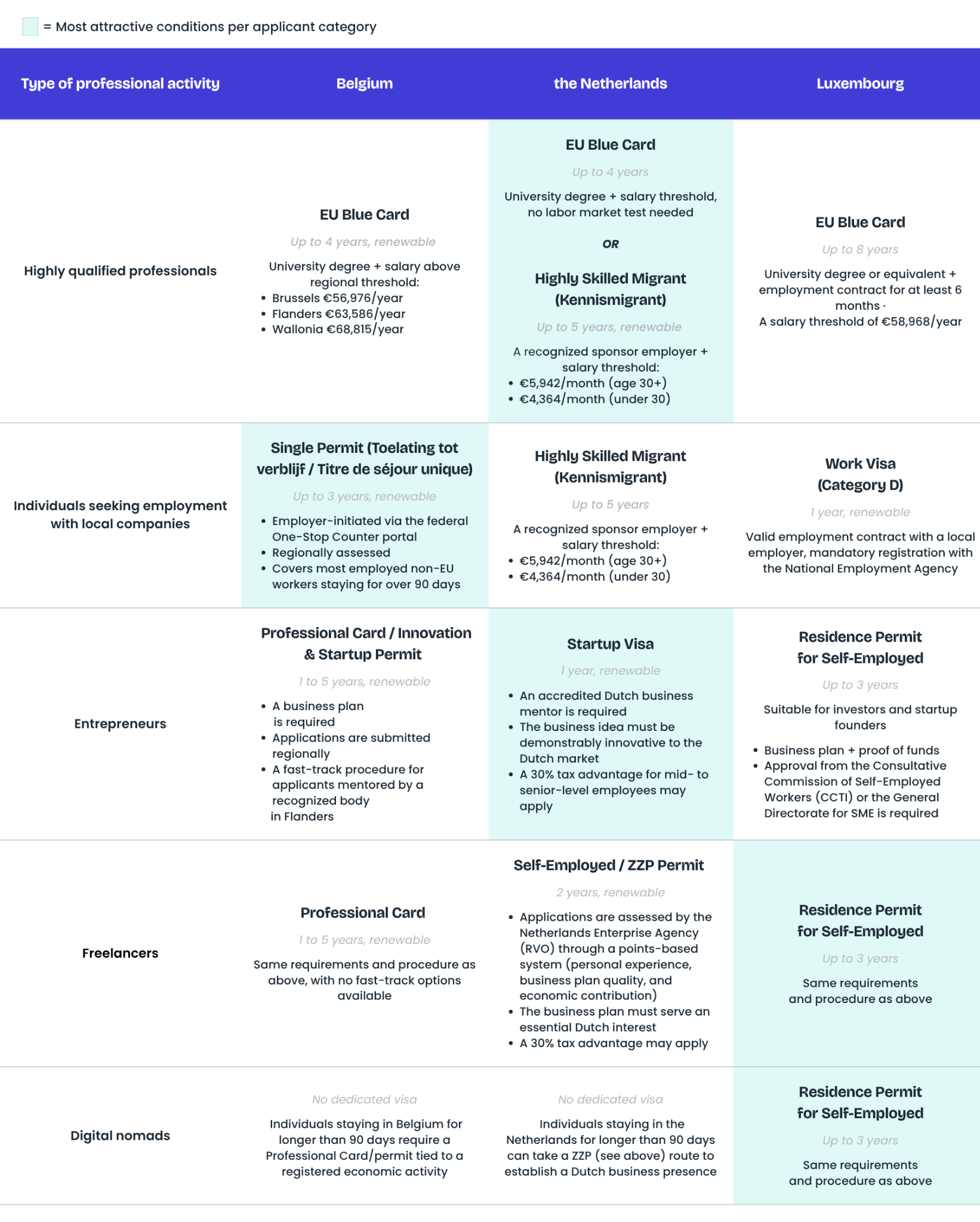
You can compare visa availability and requirements throughout Benelux for different types of professional activity in this table:
Do foreign citizens need to pay tax and social security contributions in Belgium, the Netherlands, and Luxembourg?
All three countries follow a common EU progressive tax pattern applicable to individuals getting their income from employment or business activity while residing locally, but the tax rates (as well as possible deductions) and social security contributions vary across the region:
- In Belgium, the personal income tax in 2026 ranges from 25% for individuals earning ≤16,720 EUR per year to 50% for those earning over 51,070 EUR. On January 1, 2026, the country also introduced a 10% capital gains tax on financial assets. Social security contributions are split between the employee (13.07% of gross salary) and the employer (an additional 25-27%), making the burden heavily tilted towards the employer. Self-employed individuals also pay mandatory social security contributions – approx. 20-21% of net profit, with annual minimum and maximum thresholds. Qualifying expats enjoy a tax-free lump sum from their remuneration – 35%, with the first 30% exempt from both tax and social security, and the remaining 5% exempt from tax but still subject to social contributions.
- In the Netherlands, individuals who haven't reached the state pension age are taxed 35.75%, including both income tax and social security contributions, if they earn ≤38,883 EUR per year. For annual incomes above 38,883 EUR, a 49.50% rate applies. Unlike most European countries, Dutch residents do not have medical insurance included in their social security contributions and must cover it independently instead (approx. 125-160 EUR per month for adults). Meanwhile, expats enjoy one of Europe's most generous tax benefits of the sort: 30% of their gross salary can be paid out as a tax-free expense reimbursement, reducing the effective tax rate from 49.50% to approx. 34-35% for most salary levels. The national corporate tax is set at 19% for up to 200,000 EUR profit, and 25.8% above.
- Residents of Luxembourg earning ≤13,230 EUR per year are exempt from income tax. Subsequent earnings are taxed progressively, varying from 8 to 42%, plus an additional solidarity tax for high earners. Compulsory social security contributions apply, and the corporate tax is approx. 24-27% after municipal business tax. Expats can enjoy an attractive 50% tax exemption on earnings below 400,000 EUR for up to 8 years, provided qualifying conditions are met.
Can expats live and work in Belgium, the Netherlands, or Luxembourg without speaking the local languages?

Belgium officially recognizes three languages: Dutch (Flemish), French, and German. In practice, English functions as a de facto fourth working language in Brussels and major Flemish cities, but the picture varies strongly by region. While newcomers can absolutely survive without local languages in the professional bubble, especially if they work for multinational companies, the more competitive the job market, the higher their chances of securing a local employer if they additionally speak French or Dutch. For long-term residency, proof of language proficiency may be required.
With approx. 93% of Dutch population speaking English fluently, the Netherlands is the most English-proficient non-Anglophone country in the world. English is the working language in tech, finance, logistics, and virtually all international environments. Many Amsterdam-based companies operate entirely in English internally. Dutch language skills are increasingly expected for senior and management roles, and permanent residency requires A2 Dutch.
Luxembourg has three official languages: Luxembourgish, German, and French. English functions as the lingua franca of the banking and finance sectors and EU institutions, and in practice, French or English alone is sufficient for daily life and most professional environments. No language proficiency requirement is attached to work/residence permits, and Luxembourgish is only formally required for citizenship applications.
What is life like for expats in Belgium, the Netherlands, and Luxembourg?

Belgium offers a high standard of living to locals and internationals alike. The most popular expat hubs include: Brussels (the nation’s capital, cosmopolitan and English-friendly); Antwerp (an important port and home to luxury industries like fashion, design, and diamonds); Ghent (commonly considered the country’s most liveable city); Leuven (home of KU Leuven, which is consistently ranked among Europe's top 10 research universities, a great place for academics and those in the life sciences sector); and Bruges (smaller, quieter, an iconic tourist destination).
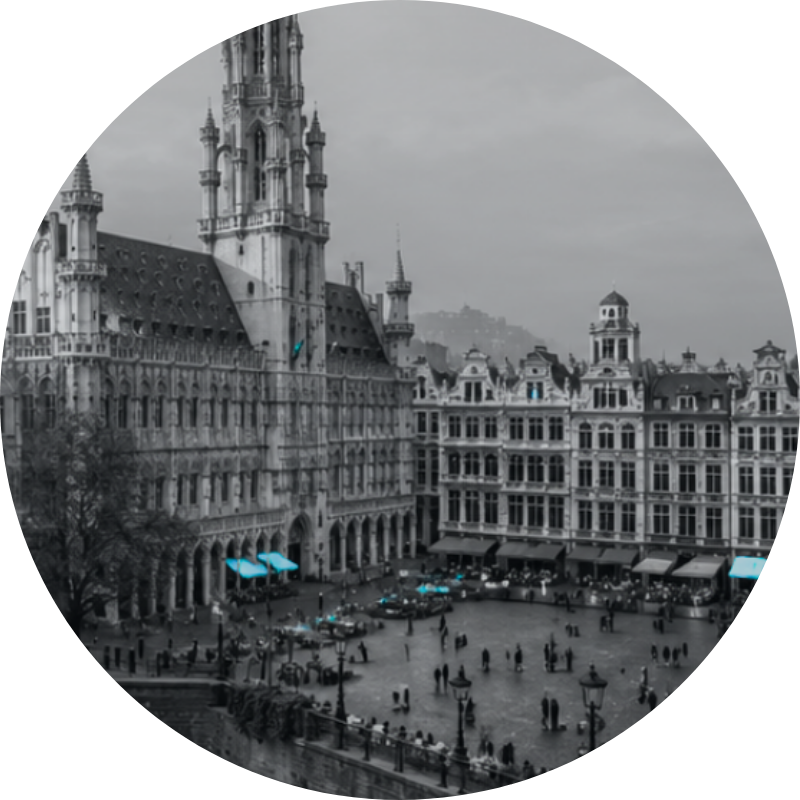
比利时月租金 在小城镇,一居室的月租金从850欧元起,而在大城市则为1000-1400欧元,具体取决于地理位置。每人每月食品杂货费用为300-400欧元,水电费另加150-200欧元。从文化角度来看,比利时是那些喜欢小确幸的人的绝佳选择:美食和啤酒在这里的社交生活中占据核心地位,拥有超过1500种啤酒和众多美食餐厅。这个国家以其精湛的工艺引以为傲,从建筑到标志性的比利时巧克力,都为日常生活增添了独特的丰富性。
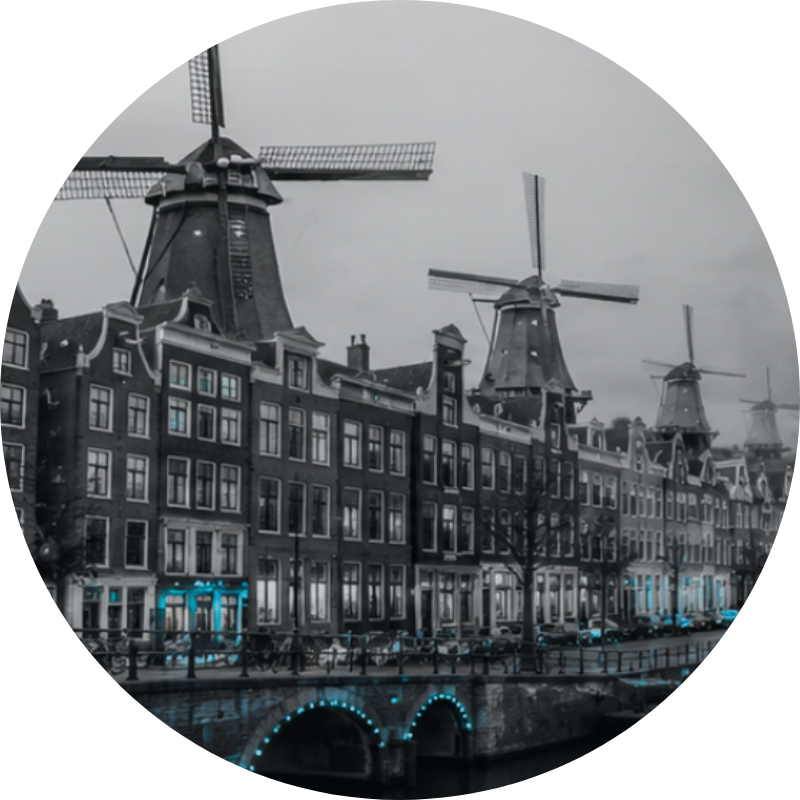
荷兰 在大多数方面都比比利时昂贵,但作为回报,你将获得一种近乎哲学般的工作与生活平衡理念、闻名遐迩的自行车友好型城市设计,以及 gezelligheid ——一种渗透到社交和职业生活中的温暖与舒适感——以及一个在个人自由、LGBTQ+权利、思想和文化交流方面,世界上最进步和最包容的社会。
该国热门的外国人居住地包括: 阿姆斯特丹 (全球科技、金融科技、创意产业和媒体中心); 鹿特丹 (欧洲最大的港口,价格明显更实惠,并拥有独特的城市形象); 海牙 (国际机构之都); 乌得勒支 (常被称为一个更小、更宜居的阿姆斯特丹,拥有同样的运河环绕的历史魅力,但游客较少,社区氛围更紧密); 埃因霍温 (该国的科技创新引擎,ASML和Brainport集群的所在地);以及 格罗宁根 (学者和研究人员的首选)。
租金方面,阿姆斯特丹市中心一居室公寓每月1,800-2,400欧元,其他主要城市则为1,200-1,900欧元。每位成年人每月食品和水电费各需150-250欧元。如上所述,每月医疗保险费由个人承担,因此在估算预算时必须将其考虑在内。
卢森堡 地处法国和德国文化交汇处,近一半人口由外国居民组成,使其成为一个在小片土地上汇聚了多元文化的国家。该国可以说是比荷卢三国中生活质量最高的,其物价也反映了这一点。卢森堡明显比比利时昂贵,与荷兰大致相当或略高,尤其是在住房方面。有关更详细的生活成本分析,请参阅我们的 专属指南。
考虑移居比利时、荷兰或卢森堡工作或经商?
借助 Acvian,更快、更轻松地开启您的旅程。 凭借便捷的 EOR 解决方案,我们可以在当地代表您招聘和管理团队,无需设立法律实体。我们的EOR服务还允许员工和远程工作者在为外国公司工作的同时,在当地居住并纳税。
我们的团队对当地情况有深入了解,乐意为您提供详细信息。
与我们的专家预约会议 或 提交申请表,我们会尽快与您联系!
Related articles for you
.png)
.png)
.png)
我们雇佣您的团队在欧洲


.svg)