
.svg)


.svg)
.svg)
.svg)
.svg)
.svg)

Resources
Blog
Case Studies
War in UkrainePrivacy Policy
Terms and Conditions
FAQ
.png)
.png)

Acvian Platform

EOR
PEO
HR Service
to your unique needs.
Payroll
Immigration Support
international hires.

with a people-first approach to the table.
Customer care is our top priority.
About Us
Our Services
Our Team
Why Acvian
Careers
as much as our clients’.
Partner with Us
Our Offices

Benelux for expats: a comparative relocation guide to Belgium, the Netherlands, and Luxembourg
Known as the Benelux Union, or simply Benelux, the three neighboring countries of Western Europe – Belgium, the Netherlands, and Luxembourg – formed a customs union in 1948 that would later evolve into a broader model of regional economic cooperation. Despite shared borders and relatively modest territories, the region is a study in unity in diversity, with a patchwork of both official and unofficial languages shaped by centuries of sitting at the crossroads of Germanic and Latin Europe, and cultural distinctions that shouldn’t be overlooked before settling on your ideal destination among the three.
Among the things the Benelux member states do have in common is consistently ranking high in the World Happiness Report. Robust EU economies, strong safety records, and high standards of living make all three countries attractive destinations for expats. In this comparative guide, we take a closer look at the regional immigration landscape, visa paths, tax regimes, and practical realities across Benelux, with a major focus on Belgium and the Netherlands.
💡Looking for a detailed expat guide to Luxembourg? Click here to explore.
Immigration landscape and employment opportunities in Belgium, the Netherlands, and Luxembourg

In other words, who is coming and why? Broadly speaking, all three countries attract a similar profile of foreign professionals: skilled, educated, tech- and finance-savvy, drawn by the EU institutional ecosystem, high wages, and the much sought-after Western European quality of life. However, there is country-to-country nuance to immigration landscapes and in-demand industries within Benelux that is worth taking into account when thinking about 'supply and demand' on the labor market.
- Belgium, home to EU institutions and NATO headquarters, is permanently in need of policy professionals, lawyers, translators, and administrative staff, especially in the capital city, Brussels. Among other in-demand positions eagerly filled by international candidates are: IT/software developers (especially in growing startup hubs like Ghent and Antwerp), data scientists, engineers, technicians, logistics and supply chain managers (the port of Antwerp-Bruges is among the world’s largest), finance professionals, as well as healthcare specialists.
- The Netherlands, with its well-established tech and innovation ecosystem, offers plenty of opportunities for software developers (Python, Java, JavaScript, cloud/AWS/Azure), data scientists and analysts, cybersecurity, and AI specialists, and project managers. Other in-demand qualifications include life sciences and biotech (with cities like Leiden and Utrecht hosting major pharmaceutical and biotech clusters), mechanical and electrical engineering, as well as supply chain and logistics.
- Luxembourg, known as a major financial and investment fund hub, predictably offers opportunities in corresponding sectors, along with software development, data science, and cybersecurity. Beyond tech, specialists in international logistics and supply chain management are also in demand.
What types of visas are available to employed professionals and entrepreneurs in Belgium, the Netherlands, and Luxembourg?
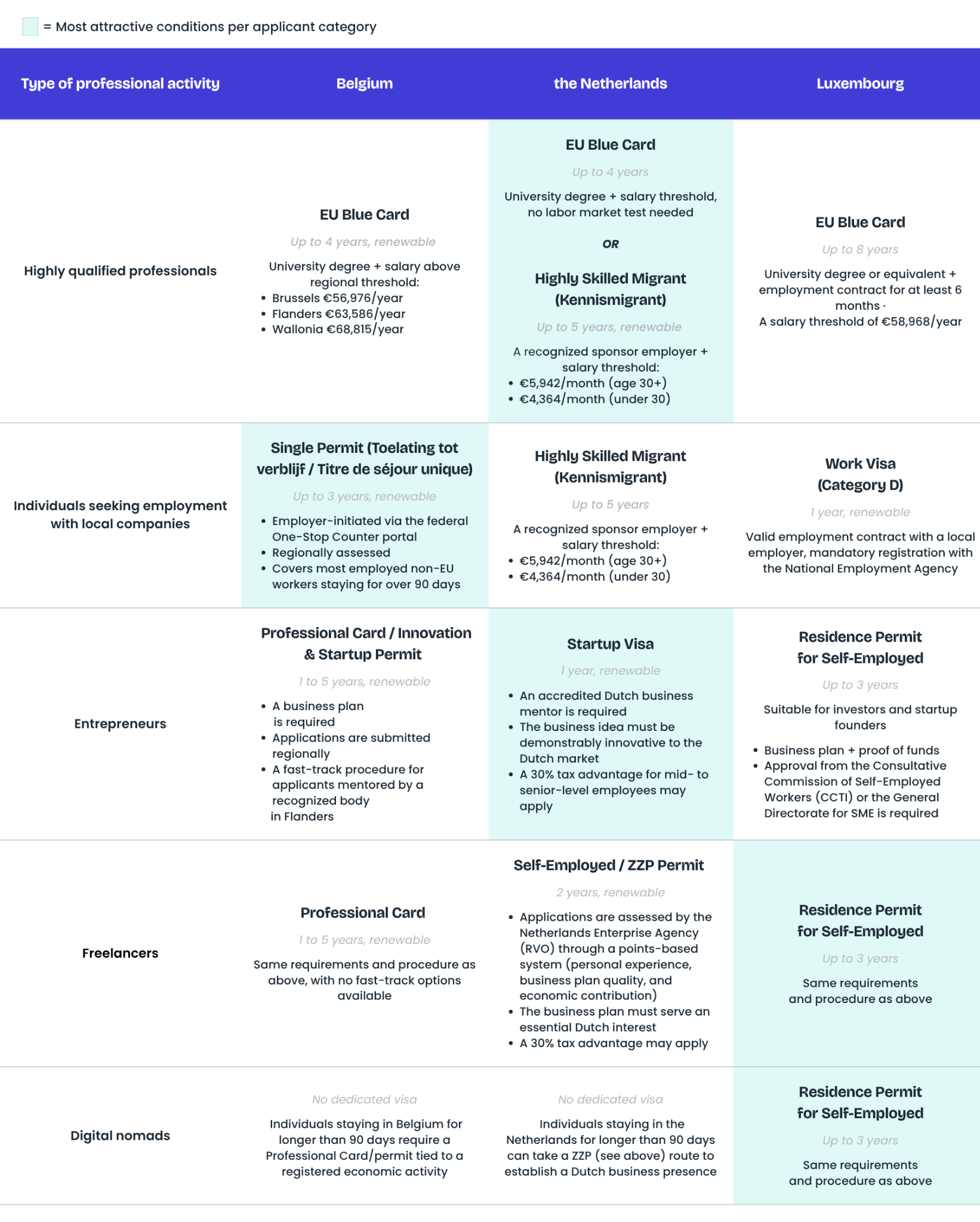
EU, EEA, and Swiss nationals enjoy free movement in all three countries and are exempt from work permit requirements (registration with local authorities applies after 3 months of stay). Non-EU nationals with university degrees or equivalent experience who seek to enter the highly qualified workforce within Benelux will be happy to hear that all three countries participate in the EU Blue Card program, with slightly varying salary thresholds and application procedures. National equivalents of generic work visas for non-EU nationals are suitable for local employment, attached to a concrete contract, and cover a broader range of roles. Self-employed individuals and entrepreneurs with non-EU citizenship can establish their activity in one of the countries through a designated visa/residence permit.
You can compare visa availability and requirements throughout Benelux for different types of professional activity in this table:
Do foreign citizens need to pay tax and social security contributions in Belgium, the Netherlands, and Luxembourg?
All three countries follow a common EU progressive tax pattern applicable to individuals getting their income from employment or business activity while residing locally, but the tax rates (as well as possible deductions) and social security contributions vary across the region:
- In Belgium, the personal income tax in 2026 ranges from 25% for individuals earning ≤16,720 EUR per year to 50% for those earning over 51,070 EUR. On January 1, 2026, the country also introduced a 10% capital gains tax on financial assets. Social security contributions are split between the employee (13.07% of gross salary) and the employer (an additional 25-27%), making the burden heavily tilted towards the employer. Self-employed individuals also pay mandatory social security contributions – approx. 20-21% of net profit, with annual minimum and maximum thresholds. Qualifying expats enjoy a tax-free lump sum from their remuneration – 35%, with the first 30% exempt from both tax and social security, and the remaining 5% exempt from tax but still subject to social contributions.
- In the Netherlands, individuals who haven't reached the state pension age are taxed 35.75%, including both income tax and social security contributions, if they earn ≤38,883 EUR per year. For annual incomes above 38,883 EUR, a 49.50% rate applies. Unlike most European countries, Dutch residents do not have medical insurance included in their social security contributions and must cover it independently instead (approx. 125-160 EUR per month for adults). Meanwhile, expats enjoy one of Europe's most generous tax benefits of the sort: 30% of their gross salary can be paid out as a tax-free expense reimbursement, reducing the effective tax rate from 49.50% to approx. 34-35% for most salary levels. The national corporate tax is set at 19% for up to 200,000 EUR profit, and 25.8% above.
- Residents of Luxembourg earning ≤13,230 EUR per year are exempt from income tax. Subsequent earnings are taxed progressively, varying from 8 to 42%, plus an additional solidarity tax for high earners. Compulsory social security contributions apply, and the corporate tax is approx. 24-27% after municipal business tax. Expats can enjoy an attractive 50% tax exemption on earnings below 400,000 EUR for up to 8 years, provided qualifying conditions are met.
Can expats live and work in Belgium, the Netherlands, or Luxembourg without speaking the local languages?

Belgium officially recognizes three languages: Dutch (Flemish), French, and German. In practice, English functions as a de facto fourth working language in Brussels and major Flemish cities, but the picture varies strongly by region. While newcomers can absolutely survive without local languages in the professional bubble, especially if they work for multinational companies, the more competitive the job market, the higher their chances of securing a local employer if they additionally speak French or Dutch. For long-term residency, proof of language proficiency may be required.
With approx. 93% of Dutch population speaking English fluently, the Netherlands is the most English-proficient non-Anglophone country in the world. English is the working language in tech, finance, logistics, and virtually all international environments. Many Amsterdam-based companies operate entirely in English internally. Dutch language skills are increasingly expected for senior and management roles, and permanent residency requires A2 Dutch.
Luxembourg has three official languages: Luxembourgish, German, and French. English functions as the lingua franca of the banking and finance sectors and EU institutions, and in practice, French or English alone is sufficient for daily life and most professional environments. No language proficiency requirement is attached to work/residence permits, and Luxembourgish is only formally required for citizenship applications.
What is life like for expats in Belgium, the Netherlands, and Luxembourg?

Belgium offers a high standard of living to locals and internationals alike. The most popular expat hubs include: Brussels (the nation’s capital, cosmopolitan and English-friendly); Antwerp (an important port and home to luxury industries like fashion, design, and diamonds); Ghent (commonly considered the country’s most liveable city); Leuven (home of KU Leuven, which is consistently ranked among Europe's top 10 research universities, a great place for academics and those in the life sciences sector); and Bruges (smaller, quieter, an iconic tourist destination).
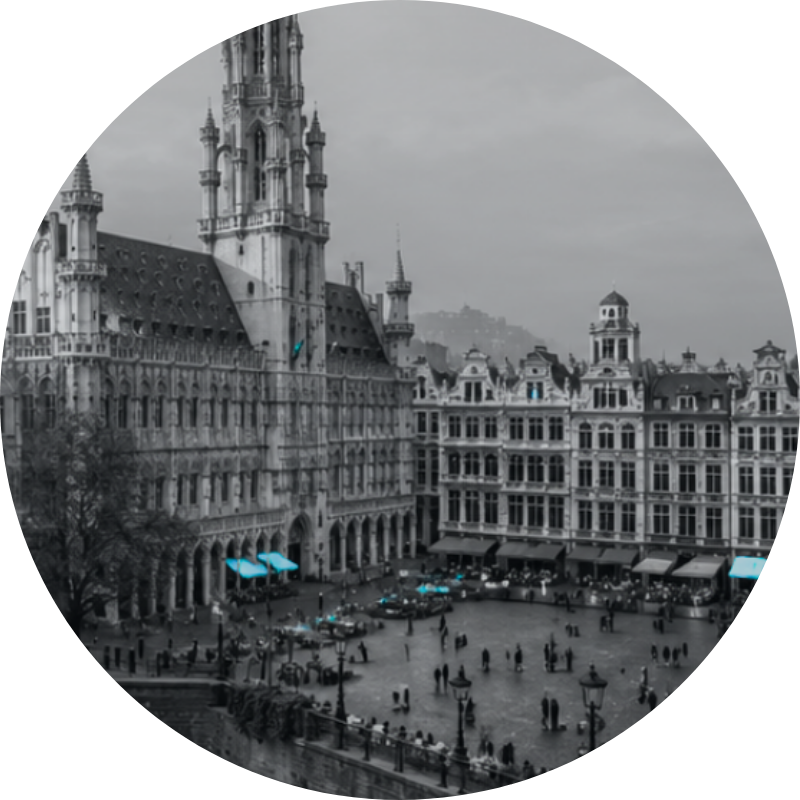
Monthly rents in Belgium vary from EUR 850 for a one-bedroom in smaller towns to 1000-1400 EUR in larger cities, depending on the exact location. Groceries cost 300-400 EUR a month per person, utilities another 150-200 EUR. Culturally, Belgium is an excellent choice for those who enjoy the little pleasures: food and beer are genuinely central to social life here, with over 1,500 beer varieties and numerous gourmet restaurants. The nation takes pride in quality craftsmanship, from architecture to iconic Belgian chocolate, which gives everyday life a particular richness.
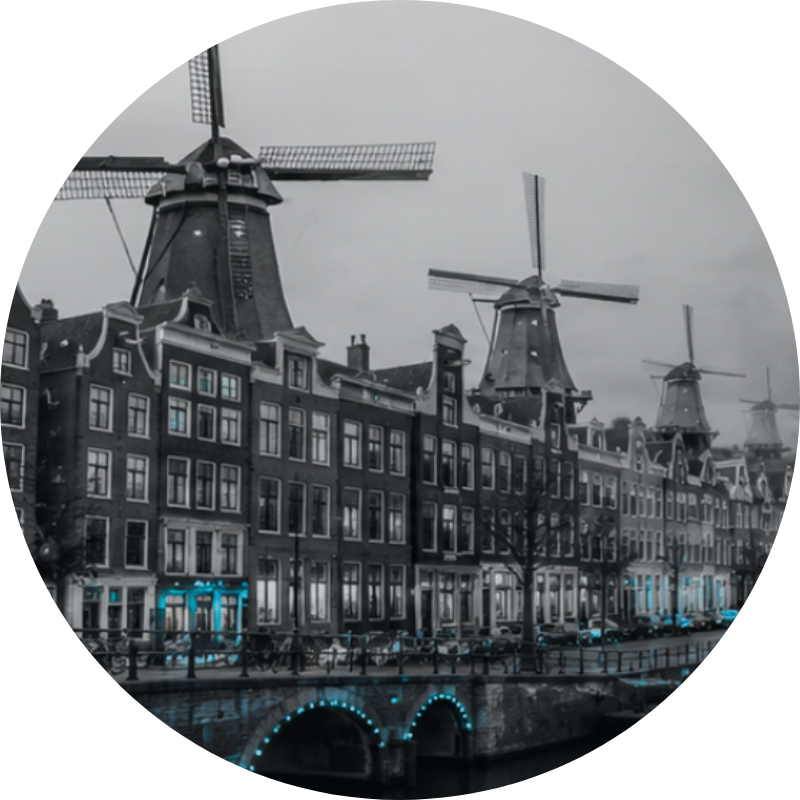
The Netherlands is more expensive than Belgium across most categories, but what you get in return is a near-philosophical commitment to work-life balance, famously bicycle-friendly urban design, the concept of gezelligheid – warmth and coziness that permeates social and professional life alike – and one of the world’s most progressive and welcoming societies when it comes to personal freedoms, LGBTQ+ rights, intellectual and cultural exchange.
The country's popular expat destinations include: Amsterdam (the global hub for tech, fintech, creative industries, and media); Rotterdam (the largest port in Europe, significantly more affordable and boasting a distinct urban image of its own); The Hague (the international institutional capital); Utrecht (often referred to as a smaller, more liveable Amsterdam, with the same canal-lined historic charm but fewer tourist crowds and a tighter community feel); Eindhoven (the country's tech and innovation engine, home to ASML and the Brainport cluster); and Groningen (the top choice for academics and researchers).
Rental costs range from 1,800-2,400 EUR/month for a one-bedroom in central Amsterdam down to 1,200-1,900 EUR in other major cities. Groceries and utilities each run 150-250 EUR/month per adult. As mentioned above, monthly health insurance contributions are covered privately and therefore must be taken into account while estimating a budget.

Luxembourg sits at the intersection of French and German cultural influences, and, with nearly half the population made up of foreign residents, it’s a dense tapestry of cultures packed into a very small territory. The country arguably offers the highest quality of life in Benelux, and it’s priced accordingly. It is notably more expensive than Belgium and broadly comparable to, or slightly above, the Netherlands, particularly when it comes to housing. For a more detailed cost of living breakdown, see our dedicated guide.
Consider relocating to Belgium, the Netherlands, or Luxembourg for employment or business?
Start your journey faster and easier with Acvian. With a convenient EOR solution, we can hire and manage teams locally on your behalf without the need to establish a legal entity. Our EOR support also allows employees and remote workers to live and pay taxes locally while working for a foreign company.
Our team has an in-depth understanding of the local landscape and is happy to provide you with detailed information.
Book a meeting with our expert or submit a request form, and we’ll be in touch with you soon!
Related articles for you
.png)
.png)
We employ your team overseas


.svg)