


Resources
Blog
Case Studies
War in UkrainePrivacy Policy
Terms and Conditions
FAQ



Acvian Platform

EOR
PEO
HR Service
to your unique needs.
Payroll
Immigration Support
international hires.

with a people-first approach to the table.
Customer care is our top priority.
About Us
Our Services
Our Team
Why Acvian
Careers
as much as our clients’.
Partner with Us
Our Offices

Hiring IT teams in Europe vs. the USA: how to benefit from talent outsourcing without operational compromises
Europe has long been a go-to talent base for US tech companies, and for good reason. Alongside Western hubs like Ireland, the continent’s central, eastern, and southeastern regions have grown into particularly attractive markets for tech hiring.

Local IT specialists are highly qualified, and their English is excellent: Poland, Czechia, Bulgaria, and Romania all rank among the top 25 in the global EF English Proficiency Index. Tech investment is also heavily incentivized by national governments (e.g., income tax exemptions for new IT and R&D projects in the Polish Investment Zone, and up to 10 years of corporate tax relief for new software development centers through the CzechInvest agency). All of this is backed by a robust EU legal framework that gives businesses certainty and predictability.

For US employers, two real questions remain:
Does hiring in the region make financial sense once Europe’s notoriously high employer contributions are factored in?
and
Can a team separated from you by several time zones perform as well as one you’d hire locally?
As we will explore below, with IT talent outsourcing in Europe the numbers still add up. And intermediary solutions such as an Employer of Record can take care of both the daily admin across time zones and cross-border payroll.
IT talent outsourcing in Europe: are the total costs worth it for US employers?

Converted to USD, European IT salaries are lower on paper than those of their US counterparts. Part of the reason is that US pay reflects a higher cost of living in major tech hubs. But one is often surprised by how big the gap is between the number in a European employment contract and the amount that actually hits the employee’s bank account after income tax and social security contributions are deducted. On top of that, there are employer contributions to pay.
Beyond Central and Eastern Europe, there are IT hubs such as Portugal, Cyprus, or the Baltics. While median salaries and the type and size of social security contributions vary from country to country, there’s a general rule of thumb: even after all mandatory contributions, a developer in these hubs typically costs an employer around half as much as a comparable hire in the US, or less.
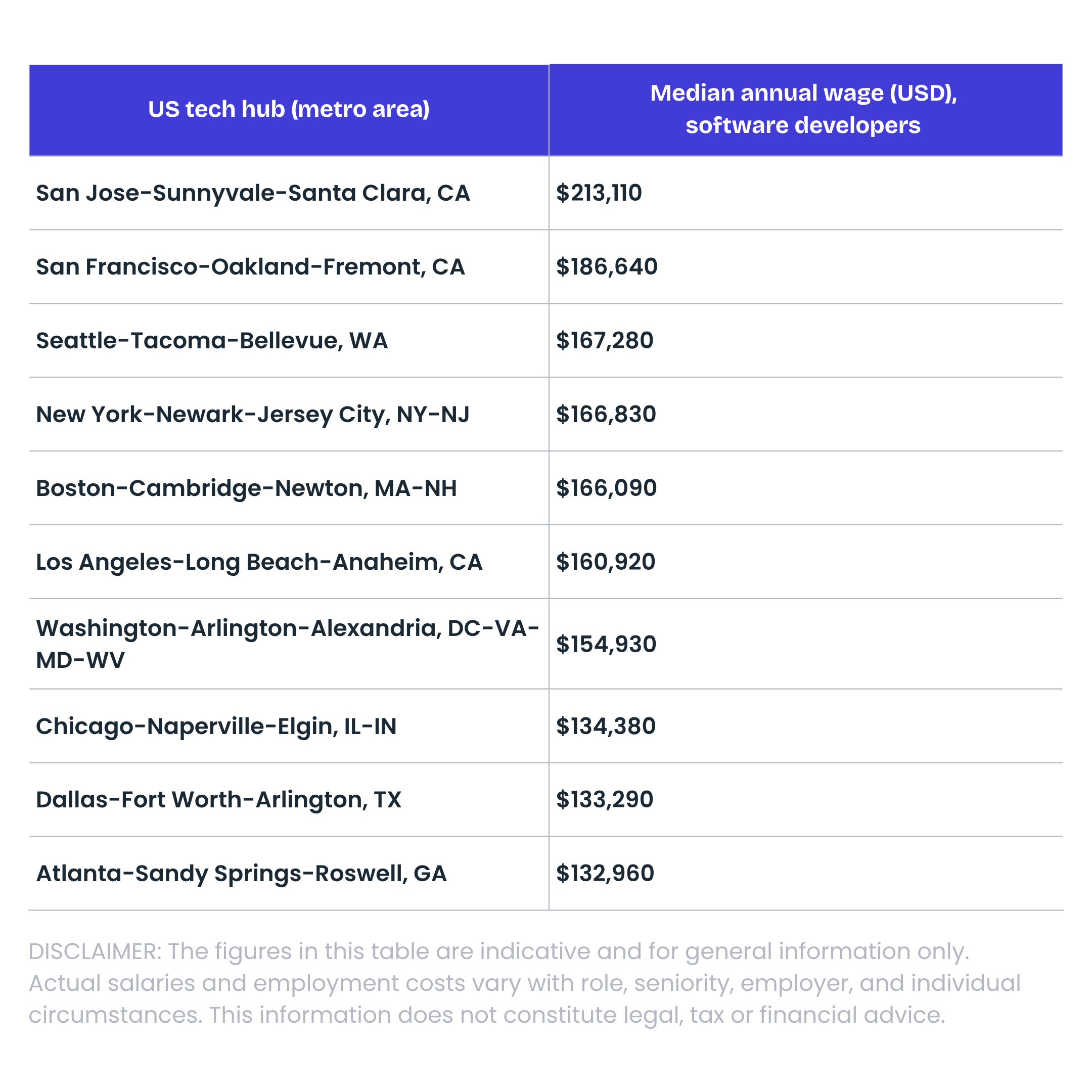
As of 2026, here’s what the median annual wage for software developers looks like in the ten largest US tech hubs, according to the US Bureau of Labor Statistics (May 2025 data):

To give you an idea of why tech talent outsourcing in the EU makes financial sense, we’ve also compared median software developer salaries in local currencies and in USD, mandatory employee and employer contribution rates, and the total annual cost to the employer across eight European tech hubs:
Time zones, working hours, and PTO: how to manage an outsourced IT team in Europe?
Across the EU, working time is regulated by law. The average working week is capped at 48 hours, including overtime, and guarantees every employee at least 4 weeks of paid annual leave. National rules are built on top of that. For example, in Poland, employees get between 20 and 26 days of paid leave (depending on the number of years worked); in Czechia, 4 weeks per year (counted in hours); in Romania, Bulgaria, and Cyprus, 20 working days.
Overtime is limited too, and usually paid at a premium, so you can’t simply ask your team to stay late to match your schedule.

Then there’s the time difference. Central and Eastern European hubs are 6 to 7 hours ahead of the US East Coast and 9 to 10 hours ahead of the West Coast. With standard working hours, that leaves a window of only 1 to 2 hours with New York, and none with San Francisco. Shifted working hours and asynchronous arrangements help, but the gap never disappears completely. Onboarding, contracts, paperwork, payroll, and leave requests come up in the middle of a European workday and need answers the same day.
An HR team thousands of miles away, working on US time, will struggle to keep up, and every unanswered question disrupts the actual work.
That’s why countless US tech companies are already using Employer of Record (EOR) services, which may also be known as international or global PEO and have identical functionality in Europe, with EOR actually covering a broader scope of tasks. An EOR is legally and locally present in the country or countries where your European IT team sits. It speaks the local language, works in the local time zone, and handles payroll, taxes, and contributions on both yours and the employees’ side.
Just as important, a top-rated EOR offers HR software for document storage, payroll administration, and employee lifecycle management, with round-the-clock access. For a US company managing an overseas team, it’s a lifesaver; even with a monthly per-employee service fee on top, hiring through an EOR in Europe still costs significantly less than hiring the same talent in the US.
Is your company looking for a competent Employer of Record to support IT talent outsourcing in Europe?

Save time, resources, and headspace. Entrust work-related immigration to a locally present and truly competent third party. Acvian is an EOR provider with a multilingual team and current active projects across Europe. We handle employee onboarding, manage taxes and payroll in the EU, and ensure compliance with the local law at all stages of employment.
On top of that, we offer competitive pricing and true customer care with fast response times in your preferred time zone. To get started, simply book a meeting with our expert or submit a request form.
Related articles for you


We employ your team overseas


